


POT Project: Food, medicines, dietary supplements
Course description
The course, which has a multidisciplinary approach, describes the salient aspects of products related
to human and animal health and provides useful information on their correct use
in order to avoid the potential risks associated with inappropriate use.
It is aimed at secondary school teachers. It is divided into 4 modules, which are further organized into teaching units. The different modules cover different types of products, such as medicines, cosmetics, food supplements, and food.
Module 1
What risks to human and animal health lurk in food?
The module aims to illustrate and explain what contaminants can
enter the food chain and how. In addition to traditional potentially toxic substances (e.g., heavy metals), we will discuss “emerging contaminants,” focusing on substances from the pharmaceutical/cosmetics industry (e.g., residues of drugs and personal care products).
Module 2
Do you know how to use a medicine correctly?
The module aims to guide you in correctly reading the label and package insert of a medicine. It also aims to explain the logic behind prescription methods, correctly interpret
advertising messages, and clarify the use of equivalent medicines and online sales.
Module 3
When and how should antibiotics be used?
The module aims to provide up-to-date scientific tools to promote critical awareness of the importance of responsible antibiotic use. This could be an important tool
in combating the emergence of antibiotic resistance.
Module 4
Is everything that is natural and found in dietary supplements harmless and good for you?
The module aims to define what is meant by a dietary supplement,
focusing on what may be bioactive components, with a particular focus
on products of plant origin. Some examples will also be introduced to
highlight the risks of inappropriate use of plants and products derived from them.
The final exam consists of a multiple-choice test.
The course is available on the SOFIA platform.

- Promote a new environmental awareness, providing teachers with tools to assess ecological issues and spread “green” habits that reduce the use of toxic substances in ecosystems and food.
- Encourage a critical and multidisciplinary approach to information on health products, helping teachers guide students in evaluating messages from the media, social networks, and popular beliefs, and raising awareness of the risks associated with the misuse of drugs, cosmetics, supplements, and food.
- Spreading knowledge about the correct use of antibiotics, so that teachers can teach students responsible behaviors that help limit the problem of antibiotic resistance.
- Supporting an informed understanding of natural products and supplements, promoting a reflective attitude towards the concept of “natural” and a balanced assessment of benefits and risks, in light of regulations and scientific evidence.
Head
Prof. Marina Gallarate
Trainers
Prof. Agnese Giacomino (Associate Professor, DSTF)
Dr. Paolo Inaudi (Research Fellow, DSTF)
Prof. Marina Gallarate (Associate Professor, DSTF)
Prof. Cecilia Cagliero (Associate Professor, DSTF)
Prof. Margherita Gallicchio (University Researcher, DSTF)
Module 1. Four 20-minute teaching units (Lecture-based teaching)
1. Traditional contaminants in the environment
2. Emerging contaminants in the environment
3. Traditional contaminants in food matrices
4. Emerging contaminants in food matrices
Module 2. Four 20-minute teaching units (Lecture-based teaching)
1. Definition of medicine
2. When a doctor's prescription is necessary and when it is not
3. Reading the label and package insert
4. Equivalent medicines
Module 3. 4 teaching units of 20 minutes each (Lecture-based teaching)
1. What are anti-infective drugs?
2. Antibiotic resistance: what it is and why it concerns us
3. How to communicate the correct use of antibiotics
4. The future of the fight against infections: what schools and society can do
Module 4. 4 teaching units of 20 minutes each (Lecture-based teaching)
1. Food supplements: definition and regulations
2. Botanicals: definition and scope of application
3. Active ingredients of natural origin
4. Appropriate use of plants
Duration
16 teaching units, each lasting 20 minutes
Frequency
The course is available via MOOC, completely online and asynchronous. To progress through the modules, you must watch the individual videos.
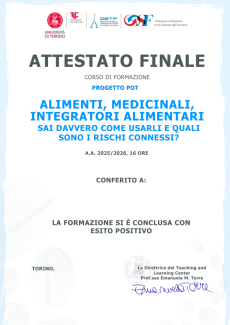
Upon completion of all modules and the final test, a certificate will be issued on Moodle, including your first name, last name, and date of completion.